
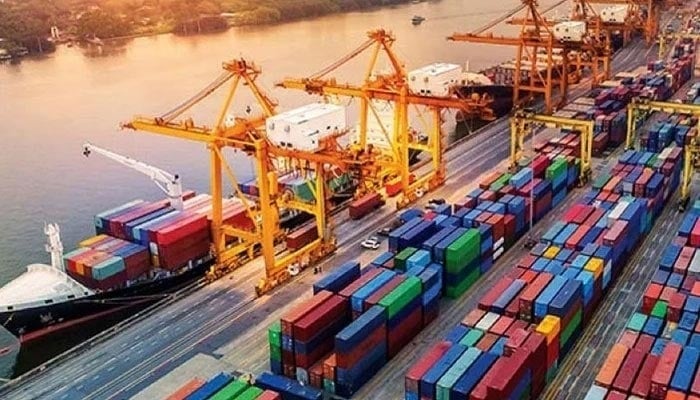
The International Monetary Fund (IMF) has urged a revision of Pakistan’s import records and statistical reporting system following the discovery of inconsistencies estimated at between $30–35 billion in the nation’s trade statistics over the past seven years. This problem has sparked doubts regarding the trustworthiness of Pakistan’s official economic statistics and led the IMF to call for prompt rectifications as a condition of its continued financial cooperation with the country.
The issue was underscored in the IMF’s recent staff-level report, published after the authorization of a $1 billion installment under the Extended Fund Facility (EFF). Although the IMF indicated that Pakistan’s balance of payments figures prepared by the State Bank of Pakistan (SBP) are not expected to be impacted, it stressed that discrepancies in merchandise import statistics provided by the Pakistan Bureau of Statistics (PBS) might weaken economic planning, fiscal responsibility, and the trustworthiness of policy.
Magnitude of the Inconsistency Sparks Concerns
The IMF states that the difference between declared import statistics and figures obtained from sources reached tens of billions of dollars across multiple years. This significant inconsistency indicates flaws in the processes of data gathering, categorization, and reporting rather than simple mistakes.
Precise trade statistics are crucial for evaluating a nation’s stance in formulating monetary and fiscal strategies, overseeing foreign currency reserves, and complying with international reporting requirements. The IMF cautioned that continual errors might mislead evaluations, undermine investor trust, and hinder Pakistan’s interactions with international financial organizations.
IMF Establishes Specific Requirements for Reform
Following these results, the IMF has mandated Pakistan to perform an evaluation of the quality of its import data. This involves an examination of current data gathering techniques, aggregation procedures, and reconciliation methods employed by the statistical agencies.
As per the IMF’s requirements, Pakistan is also required to develop an updated and harmonized collection of import data accompanied by justifications for previous inconsistencies. This updated data will need to be endorsed by a committee before its public disclosure, guaranteeing transparency and technical reliability.
The IMF’s requirement highlights its focus on data accuracy as a fundamental element of robust economic management. In the absence of statistics, decision-makers are unable to identify economic issues or formulate effective policy changes precisely.
Government Pledges to Enhance Data Accuracy
The Pakistani authorities have recognized the gravity of the matter and are committed to enhancing the promptness, precision, and scope of macroeconomic statistics. Government representatives have assured the IMF that remedial measures are currently being implemented to update the nation’s system and bring it into line with global benchmarks.
In line with these initiatives, Pakistan has recently released its Agricultural Census after 15 years, offering refreshed information about a sector that employs a substantial portion of the population and plays a major role in the economy. Additionally, the publication of the Labor Force Survey and the Household Integrated Economic Survey has aided in addressing data deficiencies concerning employment, income, and living standards.
New Statistical Tools and Surveys Planned
Looking forward, the Pakistan Bureau of Statistics is set to launch a Producer Price Index (PPI) designed to monitor price fluctuations at the production stage and enhance inflation assessment. The PPI aims to bolster predictions and equip policymakers with improved instruments to evaluate cost dynamics across sectors.
Moreover, the gathering of data will commence in FY26 for significant surveys, including:
- The Census of Manufacturing Industries
- The Survey of Small and Household Manufacturing Industries
- The Family Budget Survey
These efforts seek to generate a more precise understanding of Pakistan’s economic framework, consumption trends, and manufacturing production.
Progress on Government Finance Statistics
Apart from trade data, Pakistan is advancing in enhancing the Government Finance Statistics (GFS). Following the IMF-backed GFS roadmap, the government has set up a central GFS unit tasked with gathering and categorization fiscal data at both federal and provincial tiers.
Efforts are ongoing to incorporate GFS mappings into the government’s SAP financial management platform. After the system improvements are finalized, this integration will enable Pakistan to produce reports aligned with the newest international reporting criteria, improving openness and responsibility in public financial management.
The Importance of Data Trustworthiness
For Pakistan, regaining trust in its data goes beyond a simple technical task—it represents a crucial strategic imperative. Accurate statistics are vital for attracting investors to secure international funding and carrying out reforms that can bring economic stability.
The involvement of the IMF highlights a truth: without reliable data, even policies designed with good intentions may not succeed. By tackling flaws in its infrastructure, Pakistan has a chance to enhance institutional strength, elevate governance, and foster confidence among both local and global parties.
The IMF’s call for an audit of Pakistan’s import figures after uncovering $30–35 billion in inconsistencies represents a pivotal point for the nation’s economic oversight. Although these revelations have highlighted flaws, they have also generated impetus for urgently needed reforms in Pakistan’s statistical system.
If implemented effectively, these reforms can lead to more transparent reporting, stronger policymaking, and greater confidence in Pakistan’s economic direction. The coming months will be crucial in determining whether Pakistan can turn this challenge into a foundation for lasting institutional improvement